
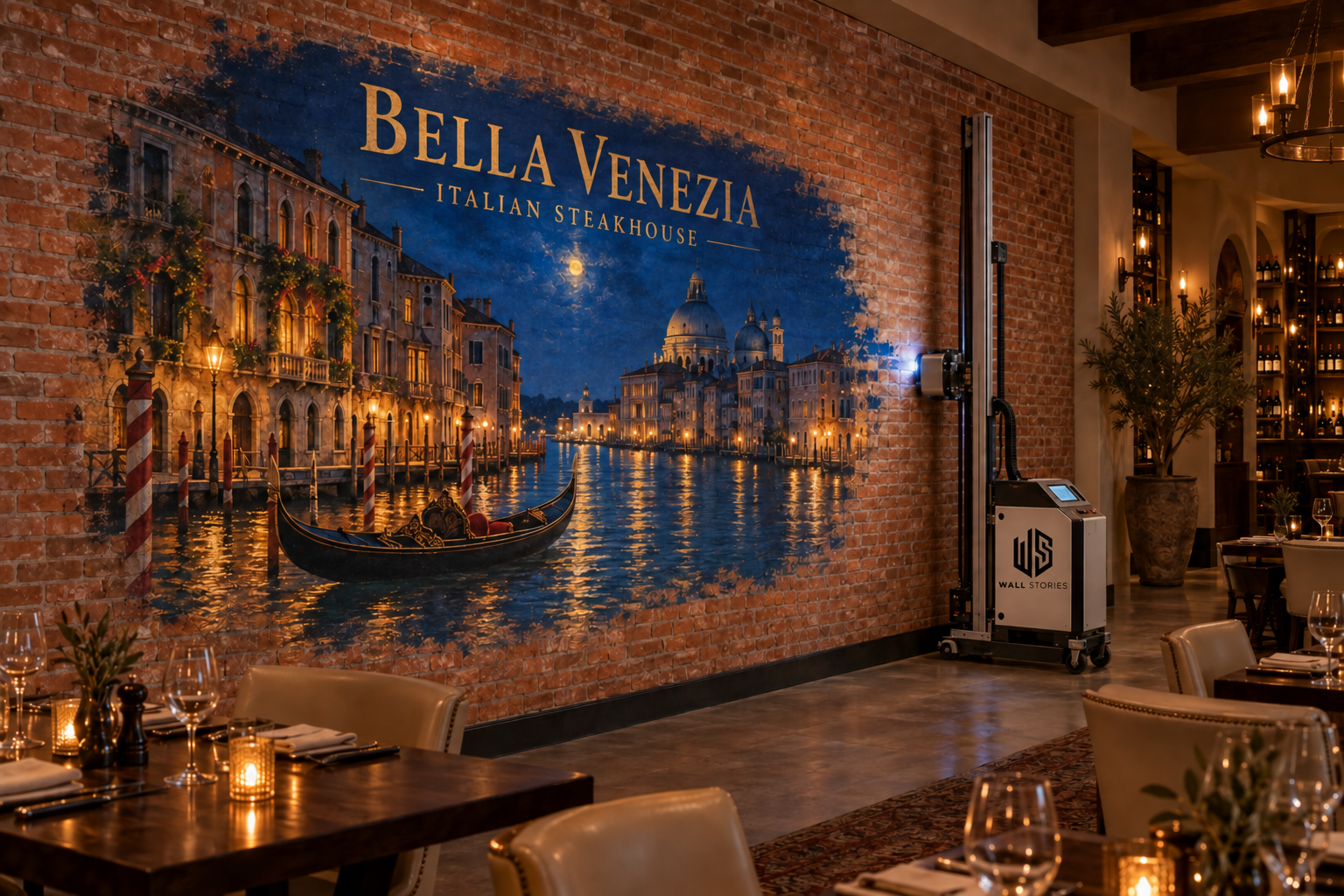
How much does a custom wall mural cost?
There is no single price that accurately describes every project. A reception logo, a restaurant panorama, and a room-spanning residential illustration may require very different scopes. For Wall Stories Creative, request a project-specific quote based on your wall and artwork rather than treating an online average as a fixed rate.
Manufacturer Vertical Printers’ operator guidance identifies setup and job complexity as pricing considerations. That guidance is industry context, not a Wall Stories price list. Confirm the actual inclusions and any separate charges in your own proposal.
1. Printed size—not only total wall size
Send the full wall dimensions and the approximate area you want the design to occupy. An eight-foot-wide wall does not necessarily call for eight feet of artwork. A focused logo composition and a large scenic mural can use the same wall in very different ways.
Wall Stories plans artwork to feather or fade before the top, bottom, left, and right physical boundaries. Agree on the intended printed dimensions and clear space before using area to compare quotes.
2. Artwork development and revisions
Explain whether you already have approved artwork, need an existing image adapted, or are starting with a new creative concept. Ask what design work the proposal includes, how many review stages are planned, and how additional changes would be handled.
A mood board communicates direction, but it is not the same deliverable as final production artwork. Our guide to artwork files for a custom wall mural explains what to gather for an initial review.
3. Wall condition and preparation
Photograph the surface closely as well as from across the room. Point out cracks, damaged paint, patches, texture, and any areas you plan to repair. Do not assume a printing quote includes painting, patching, or other building work.
Ask who is responsible for preparation, what must be completed before the visit, and how the surface will be reviewed. Use our wall-printing preparation checklist to organize that information.
4. Access, furniture, and room layout
Include a wide photograph showing the floor in front of the wall, nearby furniture, doorways, and permanent fixtures. Tell the provider about stairs, loading restrictions, limited parking, or building access procedures.
For an office, identify desks or reception furniture that can move. For a restaurant, explain whether booths are fixed. For a home, show the route from the entrance to the room. These details help define the visit before a price and schedule are agreed.
5. Production approach
Compare proposals for the same intended result. A quote for direct printing is not automatically equivalent to a quote for applied vinyl graphics or printed panels. Ask which method is proposed, why it suits the project, and what preparation and finishing are included.
If the choice is still open, read our direct-to-wall printing versus vinyl guide. Clarify the production method before judging value by area alone.
6. Scheduling and site coordination
Share the desired completion date and any practical restrictions, such as an opening event, occupied meeting rooms, or restaurant service hours. Ask whether the proposed time window is available and whether special access arrangements change the scope.
Do not assume an after-hours visit, a rush deadline, or a specific turnaround is included. Put those requirements in the initial brief so the proposal can address them explicitly.
7. Artwork permissions and outside purchases
Identify the source of any photography, illustration, logo, or other supplied content. If stock imagery or commissioned artwork is proposed, ask whether any licensing or purchase cost is included and who is responsible for obtaining the necessary permission.
Keep these decisions separate from choosing a visual style. Finding an image online is a useful starting reference, not a confirmation that it is available for your project.
8. What happens after approval
Ask what the final approval covers: spelling, artwork version, crop, dimensions, location, and any color-review process. Also request the relevant care guidance and clarify how later changes would be assessed. Do not assume future alterations are part of the original price.
A clear approval record gives everyone the same reference for what is being produced.
How to compare mural quotes fairly
Compare the design deliverables, printed dimensions, production method, preparation responsibilities, access assumptions, review stages, installation window, exclusions, and total quoted amount. Ask whether applicable taxes and any identified additional charges are included. Two different totals may describe two different projects.
If you have a budget ceiling, share it early. Discuss a smaller focal composition, a simpler artwork brief, or a phased plan rather than removing essential preparation from the scope. These are options to explore, not guaranteed savings.
What to send for a useful estimate
Gather straight-on and wide wall photographs, approximate dimensions, close-ups of the surface, your artwork or references, the room’s purpose, access details, a desired completion date, and a budget range if you have one. Explain which parts of the project are fixed and where you are open to ideas.
Ready to discuss your mural budget?
Send Wall Stories Creative a photograph of the wall, approximate measurements, and the idea you want to bring to life. We’ll discuss the project scope and the details needed for a tailored quote.
Request a consultation